Understanding Quantum Physics: A Beginner-Friendly Introduction
Exploring the Quantum Universe
Quantum physics is the study of matter and energy at the most fundamental level. It explores the behavior of the smallest building blocks of nature (like electrons and photons), which often defy our everyday intuition. Despite its strangeness, quantum science underlies much of modern technology: it has already “given rise to devices such as lasers and transistors” and is enabling progress on quantum computers . In the tiny quantum world, particles can act like waves, exist in several states at once, and even become linked across vast distances. Understanding these surprising phenomena is key to explaining how the universe really works.
Particles Can Behave Like Waves


In quantum physics, tiny particles like electrons are not just point-like bits of matter – they also have a spread-out wave nature. A classic demonstration is the double-slit experiment: when electrons (or photons) pass through two narrow slits, they create an interference pattern on the screen, as if each particle went through both slits and interfered with itself . This shows that electrons can spread out and interfere like waves. In fact, the formal idea of wave–particle duality states that every particle “exhibits both wave and particle properties” . In practice this means each electron’s quantum wave can overlap and create ripples, just as illustrated above, even though each electron is ultimately detected as a single localized “particle.”
Everything Exists in Probabilities
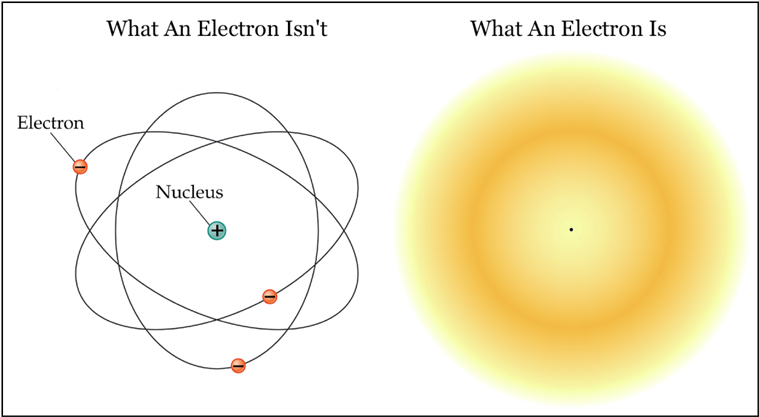
Figure: A quantum orbital (probability cloud) for a hydrogen atom. The colored cloud shows where the electron is likely to be found: darker regions are higher probability. Until we observe the electron, it is not in one definite spot but spread out in a cloud of possibilities .
Unlike a thrown baseball whose position we can pinpoint, a quantum particle’s properties are inherently uncertain until measured. Heisenberg’s uncertainty principle captures this: there is a fundamental limit to how precisely pairs of properties (like position and momentum) can be known at the same time . In effect, an electron in an atom doesn’t orbit at a fixed point; instead, it is described by a probability “cloud” (its wavefunction). As one explanation notes, a real electron “does not exist in any one place. All it has is a certain probability of being here as opposed to there” . We can only predict the odds of finding it in a given region. When we finally measure the particle, this cloud “collapses” and one outcome is realized – the particle suddenly appears at one spot. Until that moment, the particle truly exists only as a spread of possibilities .
Particles Can Be in Two States at Once(Superposition)

Figure: Schrödinger’s cat thought experiment. A cat sealed in a box with a random poison can be thought of as both alive and dead at once – a superposition of states – until the box is opened and the cat is observed .
Quantum systems can exist in multiple states simultaneously, a principle called superposition. For example, an electron can be in a “spin-up” and “spin-down” state at the same time, or it can be in a combination of two different energy levels or locations until measured. As a Caltech explanation puts it, “when an electron is in superposition, its different states can be thought of as separate outcomes… An electron might be said to be in a superposition of two different velocities or in two places at once” . A famous illustration is Schrödinger’s cat: until we look, the cat is considered simultaneously alive and dead . In practical terms, superposition is what makes quantum computers so powerful: a quantum bit (qubit) can encode 0 and 1 at the same time, allowing many calculations in parallel . Physically, any quantum wave that can overlap (like polarized light waves passing through multiple filters) is effectively in a superposition of its possible configurations.
Quantum Entanglement: The Spooky Connection

Figure: Illustration of quantum-entangled particles. Two particles of common origin (blue and red) remain linked so that measuring one instantly affects the other, regardless of the distance between them .
Quantum entanglement is the phenomenon where two (or more) particles become inseparably connected. After entanglement, the state of each particle cannot be described on its own – they share a combined quantum state. This means that if we measure one particle (say, its spin or polarization), we instantly know the result for the other, even if the particles are light-years apart. Einstein dubbed this “spooky action at a distance” because it appears as if information travels faster than light. As NASA explains: entangled particles “take on a new, united quantum state” and “if something happens to one particle, it affects all the others with which it’s entangled” . Decades of experiments (testing Bell’s inequalities) have confirmed that entanglement is real: measuring one particle’s property immediately fixes the other’s state . Entanglement is not only a fundamental curiosity but also the basis for proposed quantum technologies (like ultra-secure communication) that leverage this instant connection.
Why Should We Care About Quantum Physics?


Quantum physics isn’t just abstract theory – it’s the foundation of much of modern technology. For example, as NIST notes, quantum principles “underpin the laser,” a device that has become ubiquitous in industry and communications . Lasers are used in everything from barcode scanners and DVD players to fiber-optic internet links and medical surgery. Quantum mechanics also governs semiconductor behavior, so it’s essential for computer chips and LED lights. Similarly, MRI (magnetic resonance imaging) machines depend on quantum spin states of atomic nuclei, and the precise timing of GPS satellites relies on atomic clocks – clocks that exploit quantum superposition to keep perfect time . In short, every time you use GPS, an MRI scan, or even a laser pointer, you’re seeing quantum physics at work . Looking ahead, researchers are building on superposition and entanglement to create quantum computers and sensors that can solve problems far beyond today’s machines . Understanding quantum physics therefore means understanding the principles behind both current devices and the coming generation of technology.
Conclusion

Quantum physics reveals that the universe is far more mysterious and counterintuitive than it appears in daily life. In the quantum realm, tiny particles behave like waves, a single particle can occupy multiple states at once, and even widely separated particles can be instantaneously connected. These strange effects challenge our classical logic – as Einstein quipped, “God doesn’t play dice,” yet quantum mechanics shows the dice do roll at the smallest scales. Far from being purely theoretical, these principles are the bedrock of the modern world: they explain how lasers, LEDs, GPS, and MRI machines work, and they point the way toward new technologies like quantum computers . In exploring quantum physics, we peel back the layers of reality and gain a deeper understanding of the tiny world that underpins everything around us.
Sources: Authoritative physics sources and science outreach articles have been used to explain these concepts scienceexchange brilliant.org chem.libretexts wikipedia.org wcas.northwestern.edu sciencealert.com scienceexchange.caltech sci.news nasa.gov nist.gov


Comments
Post a Comment