Ancient Origins, Modern Glory: The Remarkable Rise of Indian Chess
The Ancient Roots of Indian Chess
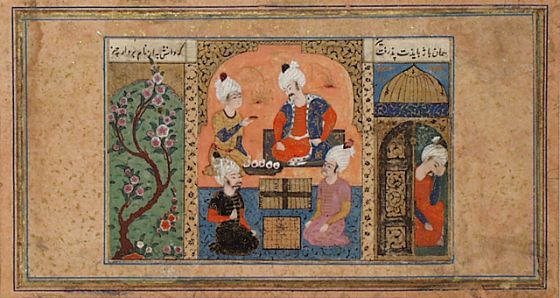

Chess traces its lineage to India. Historical records and literature describe a game called Chaturanga (“four limbs”) played in the Gupta Empire around the 6th–7th centuries CE . Chaturanga’s name reflects its four armies (infantry, cavalry, elephants and chariots), and it is widely regarded as the common ancestor of modern chess (as well as shogi and other Asian chess variants) . From India it spread westward: by the early medieval period it became shatranj in Persia, and through Arab and European transmission it evolved into today’s chess game .
Over the centuries in India itself, chess remained a learned pastime. By the Mughal era, finely carved Indian chess sets (like those made of sandalwood) were crafted – evidence of a vibrant chess culture that persisted. However, when Europeans standardized modern chess, Indians were largely spectators until the 20th century. A notable exception was Mir Sultan Khan of Punjab (1903–1966), a rural leader who defied expectations: after winning the All-India Championship in 1929, Sultan Khan travelled to England and won the British Championship three times (1933–35), even defeating former World Champion José Raúl Capablanca . His exploits in the 1930s were a rare bright spot in India’s colonial-era chess story and hinted at the country’s latent talent.
Post-Independence Revival and the AICF
India’s formal chess renaissance came after independence. In 1951 India formed the All India Chess Federation (AICF), a national body to organize the game. The first national championship was held soon after (Ramchandra Sapre became champion in 1955 ), and India fielded its Olympic team for the first time at Moscow in 1956 . Early pioneers made slow but steady progress: Manuel Aaron earned India’s first International Master title in 1961 , and women’s chess also grew (Vijayalakshmi Subbaraman became India’s first woman international master in 1996 and first woman Grandmaster in 2001). By the 1980s this groundwork paid off: in 1988 V. Anand of Chennai became the first Indian to earn the Grandmaster title , breaking new ground.
The AICF (affiliated with FIDE and the Asian Chess Federation) has since overseen India’s chess structure. It runs national championships, youth events and state associations, and it coordinates India’s participation in international competitions . Notably, the AICF organized India’s first World Chess Olympiad when Chennai hosted the 44th Olympiad in 2022 – a landmark that underscored India’s arrival on the world stage. (The Chennai Olympiad was the first time India had ever hosted this global team event .) Under recent administrations, the AICF has emphasized grassroots development and broader access to the game, helping fuel India’s broad chess revival.
Vishwanathan Anand: India’s Chess Icon
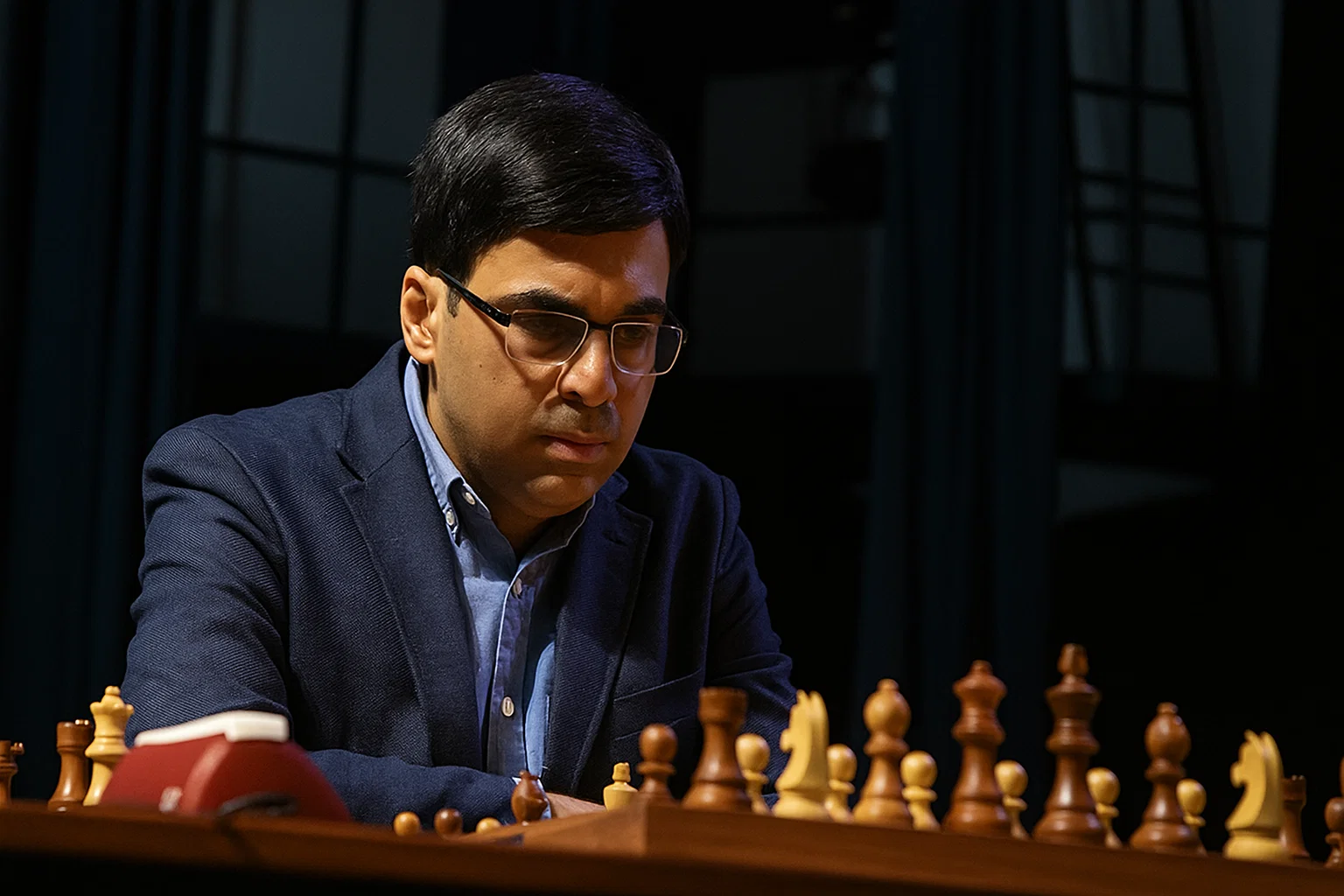
No discussion of modern Indian chess can omit Viswanathan Anand. Anand, often called “Vishy,” is a five-time World Chess Champion and the player who truly popularized the game in India . He became the country’s first Grandmaster (at age 18 in 1988) and went on to achieve the highest accolades: winning the FIDE World Championship in 2000 (defeating Spain’s Alexei Shirov) and holding the undisputed World Championship title from 2007 to 2013 . Anand defended his crown multiple times against Kramnik, Topalov and Gelfand, and only ceded the title to Magnus Carlsen in 2013 .
Anand’s international success electrified India. He received the nation’s highest sporting honors (the Khel Ratna in 1991–92 and later the Padma Vibhushan) and became a household name. As Wikipedia notes, Anand’s achievements “have had an important role in popularizing chess in India” . His calm, sportsmanlike style – earning him the nickname “Tiger of Madras” – inspired countless young players. In short, Anand transformed chess from a niche pursuit to a mainstream sport in India, paving the way for the generation that followed.
New Generation: Rising Young Talent
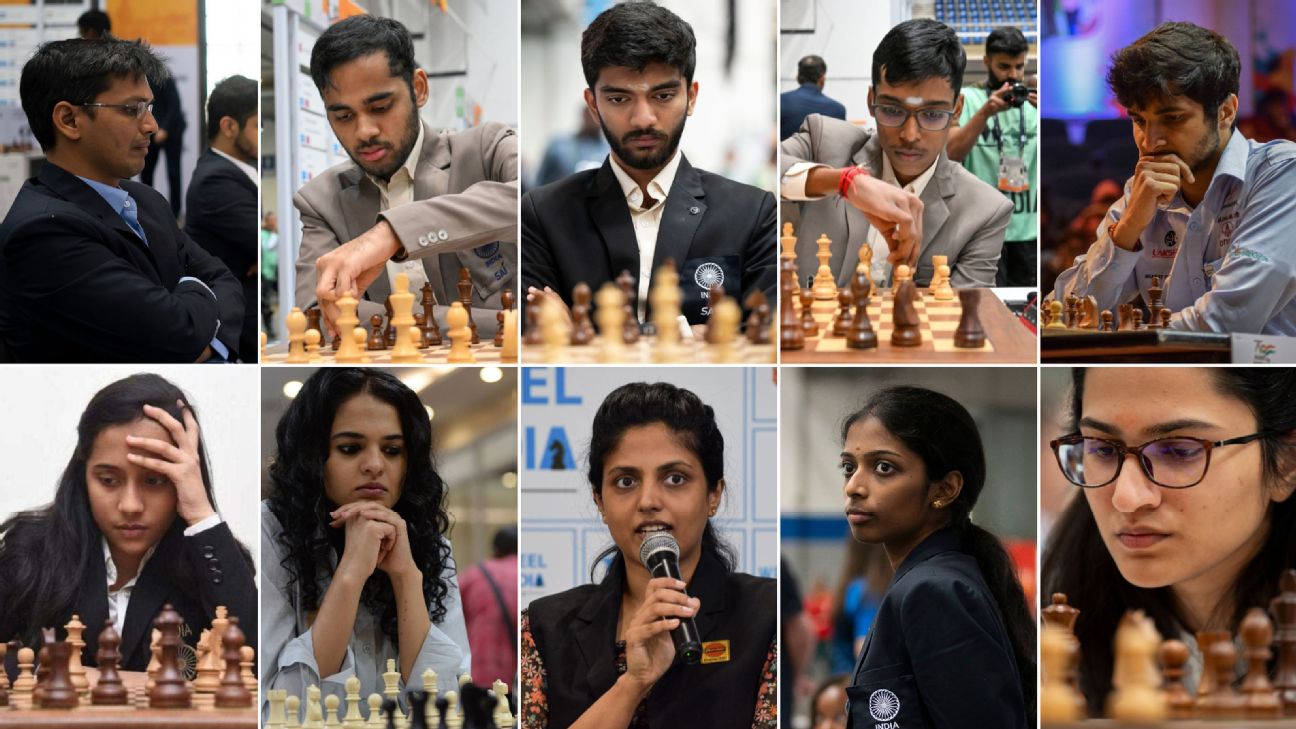
In Anand’s wake, a new wave of Indian champions has emerged. By 2025 India boasted 85 Grandmasters, with 13 of them ranking among the world’s top 100 players . Many of these are teenagers or in their early 20s. Foremost among them is Gukesh D (born 2006), who broke records by becoming (at age 17) the youngest-ever World Chess Championin late 2024 . His compatriot R. Praggnanandhaa (born 2005) likewise turned heads: he became India’s youngest GM at age 12, and in 2023 was the youngest player ever to reach the final of the Chess World Cup . Others like Arjun Erigaisi, Santosh Vidit, and Nihal Sarin are also in the world elite, frequently competing in top tournaments and holding ratings above 2700 FIDE.
On the women’s side, India has seen breakthroughs as well. Koneru Humpy (first woman GM from India in 2002) and Harika Dronavalli have long been fixtures at the highest levels, and rising star R. Vaishali (Praggnanandhaa’s sister) became a Grandmaster in 2021 and the country’s top-rated woman. These young talents have shattered age records and earned international medals, setting examples that “motivating others to pursue excellence” in the sport . In sum, India’s current squad – fueled by homegrown academies and coaches – is as strong as any in history, signalling that the nation’s chess best days may lie ahead.
The Online Chess Boom in India
The 2010s and 2020s saw a digital explosion for chess in India. Online platforms like Chess.com and Lichess have millions of Indian users. In fact, Chess.com reported an astounding 19.5 million registered users from India (out of roughly 50 million worldwide) . On average about one million Indian players are active on the site every day . The surge accelerated during the COVID-19 lockdowns when people turned to chess for mental stimulation, aided by viral media phenomena. The Netflix hit The Queen’s Gambit (2020) and countless YouTube and Twitch streams (by Indian GMs and coaches) turned millions of young people into casual chess watchers .
These changes have profoundly altered training and competition. Interactive apps allow 24/7 play, puzzles and tutorials, so that even remote learners can train with computer analysis and play opponents worldwide. Indian grandmasters have embraced these tools: “the app has made chess accessible to everyone…with puzzles, game analysis, lessons, tournaments… it’s a chess universe!” remarked Indian GM Tania Sachdev . High-profile online events – from casual Titled Tuesday tournaments to the FIDE World Championship livestreams – now command Indian attention. As one news report noted, when Gukesh Dommaraju contested the world title in late 2024, India overtook the USA as Chess.com’s most active country, with up to 17 million games played per day during the championship week . In short, online chess has transformed India’s chess scene from its roots in neighborhood parks and clubs to a digital, global battleground.
India on the Global Chess Stage

India’s rise is no longer only about numbers and ratings – it has translated into historic medals. The country won its first Chess Olympiad medal (a team bronze) only in 2014, at Tromsø . The momentum built up: as hosts in Chennai 2022, India claimed two bronze medals (in the Open and Women’s sections) . The crowning achievement came at the 2024 Chess Olympiad in Budapest. There, for the first time ever, both India’s men’s and women’s teams won gold medals . India also swept the board prizes: GM Gukesh, Arjun Erigaisi and Harika Dronavalli took individual gold on their boards, while team captain Kushagra Rawat was named best women’s reserve .
The double gold was hailed as a national triumph. Anand, speaking on the FIDE broadcast, said “It feels like a magical time for India” after the wins . Chess journalists noted that India had become “a pre-eminent contributor to chess,” reflecting a profound shift . Indeed, by late 2024 India was widely seen as a chess superpower: it had 85 Grandmastersand its top-10 players’ average rating (2721) was second only to Russia’s . With Anand now serving as FIDE Deputy President and dozens of Olympiad medals and world championship finalists to its name, India has firmly established itself at the highest level of global chess.
Sources: Extensive reporting and historical summaries (including the Chess in India entry on Wikipedia en.wikipedia en.wikipedia, IndianExpress coverage of online chess indianexpress.com indianexpress.com, FIDE/Olympiad reports aljazeera.com wikipedia.org, and interviews in media like Femina magazine femina.in femina.in ) were used to document this evolution. These sources confirm the chronology and achievements of Indian chess from its ancient origins to its current prominence on the world stage.


Comments
Post a Comment